Four-letter words

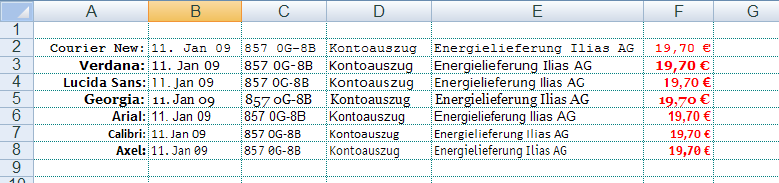
My contribution to the world of spreadsheets is called Axel. It has been writen about quite a bit already, like here, but the naming still seems to need explaining. As the illustration shows, Axel saves space while still being legible, making it a welcome typographic alternative for those poor people who have to work in Excel and other spreadsheet apps every day. So these users tell me. But one of them, Dan Reynolds, thinks it could have been even better by being called Axl.

All my typefaces have four-letter names: Meta, Info, Unit. ITC Officina came earlier and is the exception. I wanted to name this one Exel, but the people at FontShop in Berlin were a little afraid that the big company in Seattle might take exception to the obvious reference. I don’t think that would have been a problem, but then I am not the distributor. Axel is homophone with Excel, and it has four letters.excel2007-win-10pt
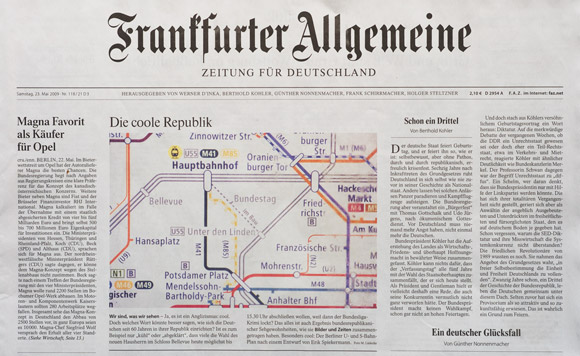
On the cover of the FAZ

The FAZ, Frankfurter Allgemeine Zeitung, is Germany’s most prestigious newspaper. Conservative in its politics, progressive (or enlightened?) in its coverage of The Arts. For the Federal Republic’s 60th anniversary this weekend they dedicated a complete section to the work of communication designers. They write about the “face of the new Germany” saying that (and I quote loosely) Our true orientation systems are pictures from daily life. Over the Federal Republic’s sixty years designers have done more for the self-image of Germans than all other professions.

Among the illustrations is the system of typefaces that I designed with Christian Schwartz and that was awarded the Federal Design Prize because – as the jury put it – “it represented a major contribution to the country’s visual culture”.

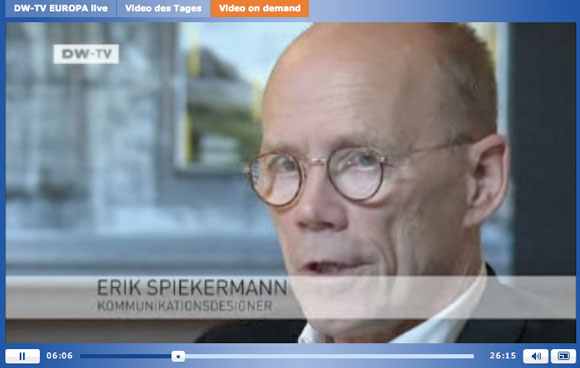
The FAZ’s cover page for 23 May 2009 shows a photograph of a piece of Berlin’s public transit diagramm, “after a design by Erik Spiekermann”. That is true, but only half the story. I lead the team that, in 1990, designed the passenger information system for the BVG (Berlin Transit Authority) in the re-united city. I was responsible for the main parameters, like typefaces, logos, colours, and overall design language. The artwork for the diagramme was done by Brigitte Hartwig, now a professor at Dessau. The up-to-date diagramme (it is not a map!) is downloadable here.
faz_230509_580px
faz_ausschnitt

DIN everywhere

The original DIN-Schrift and, above all, its cool sister, FF Din by Albert-Din Pool, is everywhere these days, not just in Germany, where it is still the official alphabet for roads and the Autobahn.

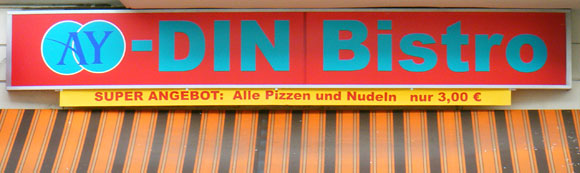
The people who run the DIN-Bistro in Berlin obviously tried to exploit the popularity of this typeface for their own purposes. Unfortunately without any typographic knowledge whatsoever. The sign above their shop is set in the infamous system font that has spread like the plague and ought to be treated as such.


bistro_din

Not an ampersand

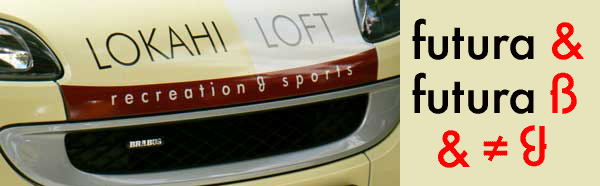
Ampersands (and-per-se-and) can look like a 3 turned sideways with a t attached: latin et. Univers looks like that, Garamond Italic looks like a real e-t ligature. Some ampersands look more like the figure 8 (Futura for example), others more like e or E gone funny.


ampersands
The one I saw on this car was a home-made variety that I had not seen before and hopefully never will. It is the ß (German double-s ligature), turned upside-down. I have no idea why this happened, as every font has the ampersand in it, even the nastiest free font. But perhaps the person who “designed” the type on this car actually preferred it this way. Everybody’s a designer.


futura_et
futurasmart

Alternate a, again

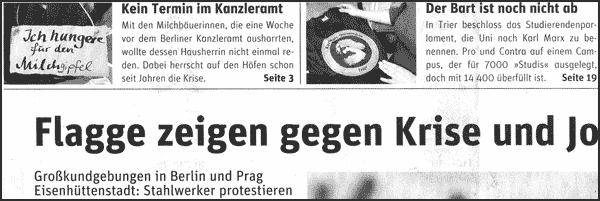
A German daily paper sets its headlines in FF Unit and uses the alternate cut for another level of hierarchy. It makes for a subtle distinction, and that’s obviously what they wanted.


nd_unitheads2

That little difference

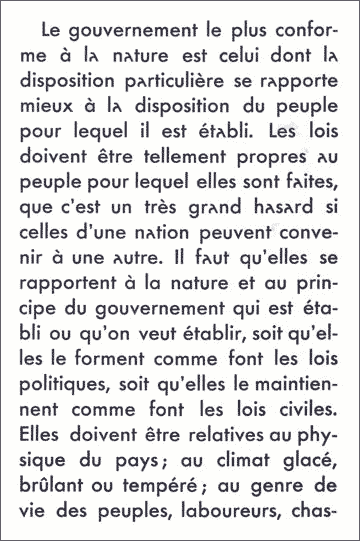
Paul Renner’s Futura was sold in France as Europe. The Bauer Foundry cast special sorts for this market: just the lower case a in a shape that evokes Carolingian minuscles. renner1It is amazing how just this one small change affects the look of the whole page. The page shown uses the alternate “French” a in its upper half, and the normal a in the bottom half. Posters by A. M. Cassandre were very well know in France during the 20s and certainly influenced all other designers. This little change in Futura suits that style perfectly. The commercial success of a typeface can depend on a change as subtle as this. The specimen is from a book about Paul Renner, published as an annual keepsake by the Typographical Society in Munich, published and edited by Philipp Luidl, assisted by Günter Gerhard Lange.