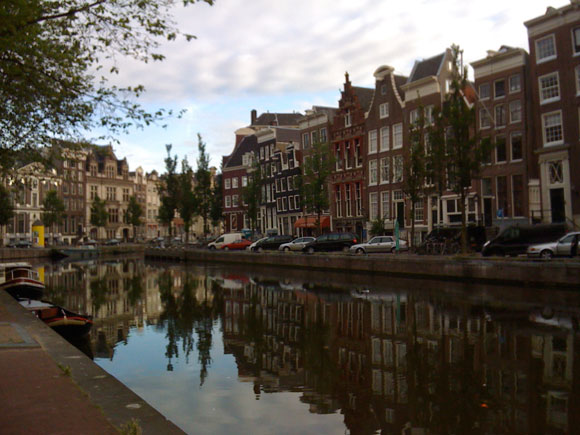
The iPhone is not a camera, it just has a cheap plastic lens, a chip and some memory dedicated to capturing and storing image data. There are no adjustments possible, all you do is raise the phone in front of you, push the button and hope that something somewhere might be in focus. Now and again, even this primitive set-up catches more than mere objects, but a mood or a feeling. At 7am one morning in Amsterdam I noticed how no boats had been on the Herengracht, leaving the water untouched and as still as a pond. It made me get off my bike and take one of those quick snaps, without considering exposure time, aperture or focus.
Publish or Perish
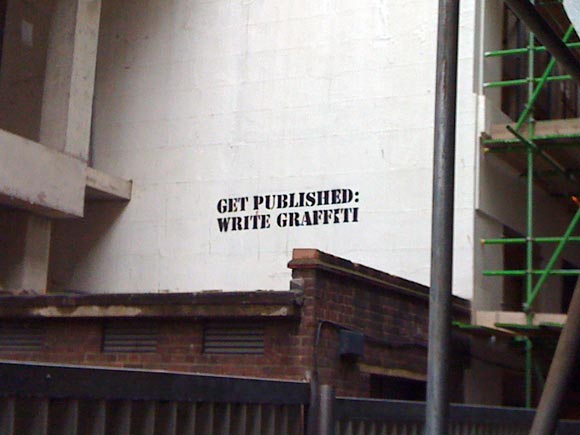
Spontaneous slogans here in London have been the subject of my deliberations before. A building site in Clerkenwell yielded this one today, done by an expert, typographically correct:
Nice face, shame about the ad

Even with an ugly ad like this, the Nokia typeface carries the brand. I designed this 8 years ago (Monotype turned my sketches into real fonts) and it’s held up pretty well.
Typomania reloaded
Under download above you can still see the bad copy of the Typomania video that I did for the BBC almost 25 years ago. Two fellow typomaniacs have taken the sound track from that video and remixed it into Typefaces give us signals. See and hear for yourselves:
Rename Capitaism!
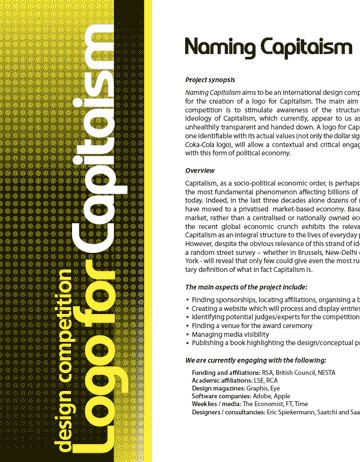 Students at the School of Oriental and African Studies in the Media and Film department have a project going called “Naming Capitaism”. The whole thing is quite cryptic: the location and proper name of the school or department aren’t given anywhere, but the phone number indicates it could be a London institution. Or is it a School of Media and Film that has a department of Oriental and African Studies? They spelled my first name wrong, as usual (what is so difficult about E-R-I-K?), and published it without asking me first. Perhaps that school needs a department of communication studies, offering classes in media planning, creative writing, copy-editing and proof-reading before their next project.
Other than that, I quite agree that Capitaism needs to be renamed. I certainly do not know what the word means.
Airtype
A Zeppelin NT has been seen above San Francisco Bay, showing tourists the sights from above. The airship is 75m (246ft) long and 17m (64ft) high. The logo Airship Venture is set in ITC Officina Bold and must be about 5m (16ft) high und 32m (106ft) long.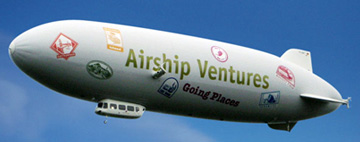
 While I am happy to see my typeface that large in the sky above, it feels strange as well. After all, when Officina was designed in the late 80s, it was meant to be used in correspondence, to replace typewriter type. It subsequently shares quite a few of those characteristics. And too bad that licenses are not paid by size.
Why The Economist is thriving
Magazines and newspapers are suffering, everywhere. Everywhere? Apparently, one of them is doing extremely well: The Economist. Michael Hirschorn argues in this article in The Atlantic that is has to do with their attitude, style of writing, careful research – in other words quality. In Hirschorn’s words, The Economist may be proof for the fact that »although digital media is clearly supplanting everything analog, digital will not necessarily destroy analog. A better word might be displace.«.
Hirschorn does not mention design, so I’ll have to do that. As I wrote in January 2007 in this very blog on the occasion of the publication of ITC Officina Display, I was responsible for the redesign of The Economist in May 2001.
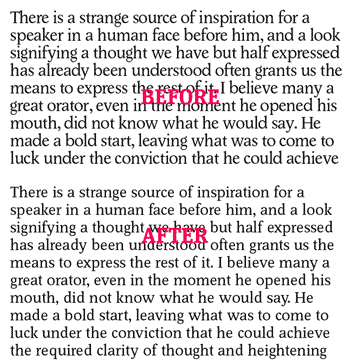
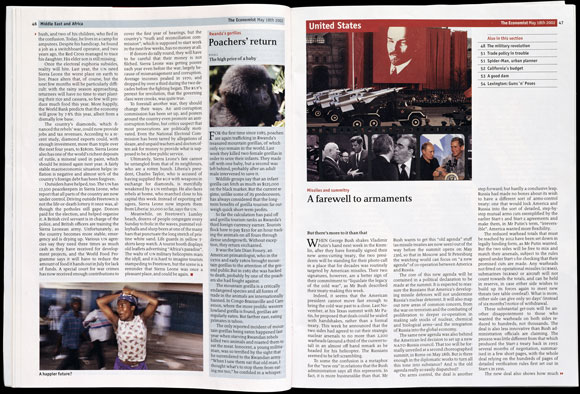
As seen here, we touched everything, including the text face. It was set smaller in the new version, but the client always thought we’d increased the type size, because it appeared bigger on the page. The images below show two typical spreads, one before, when the newspaper was printed black and white with a bit of red only, and one after, when we had gone to full colour. While I am very pleased that our design held up so well, I think that every publication needs its design evaluated every six or so years. It’s been eight years already for The Economist. Is anybody reading my blog in St. James’s Street?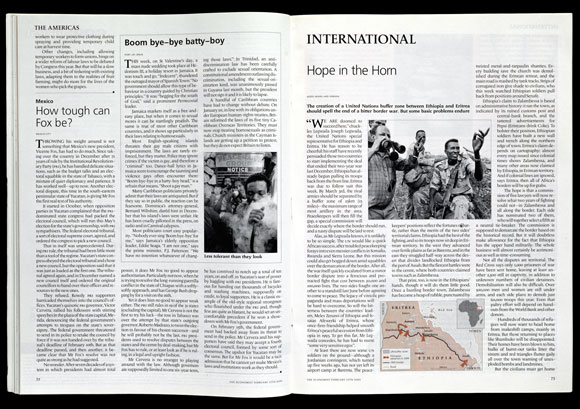
Webtrend diagram
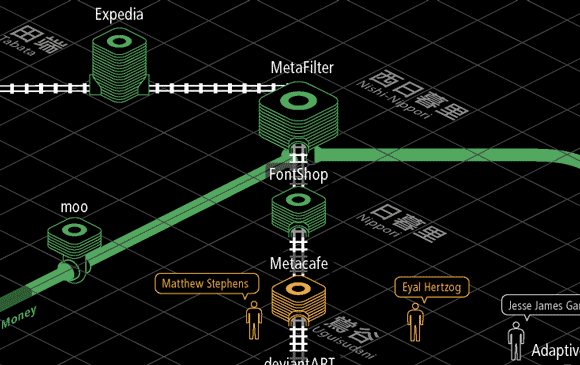
The latest diagram showing what Information Architects think are the 333 most influential websites is now available.
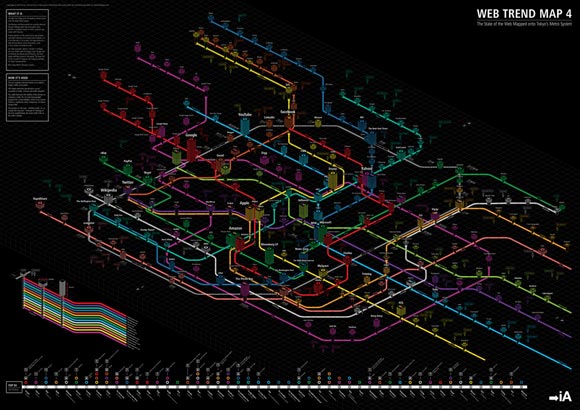
I just wish they wouldn’t call it a map, because it isn’t. It is a diagrammatic representation of a network, based on the subway system in Tokyo. A diagram isn’t necessarily an exact topographic, let alone geographic representation, it just shows relationships, not absolute or relative distances.
The cool thing is the fact that FontShop made it into the top 333.
Useless and totally cool
You can download the Now widget at sprint


Found, not lost
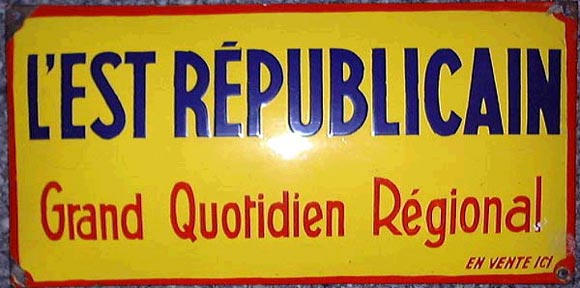
This was the first enamel sign for what was to become quite a collection of them. In 1967 we – my then.wife, Joan and myself – saw it somewhere in the South of France, next to the door of a newspaper shop. While I parked our 2CV and, using my scrappy French, tried to divert the attention of the old men who were sitting on a bench outside, Joan was busy right next to us. When we were back in the car a few minutes later, I asked her why she had been back so quickly and whether we shouldn’t offer money to buy the sign after all. I had not noticed that she had already dealt with the matter by simply sticking the sign under her short dress. It hadn’t been screwed to the wall but was simply leaning against it. Obviously as a sign for us to take it and prevent it from being thrown away the next time they painted the house. This is what happened to most enamel signs in those days.
This did not start us on a career as petty thieves, but in retrospect could have been the first activity that eventually led to us founding FontShop 20 years later. The liberation of this sign was our first typographic misdeed.