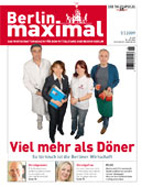
Typographic half-knowledge

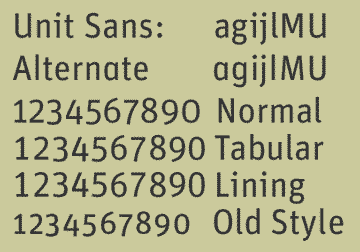
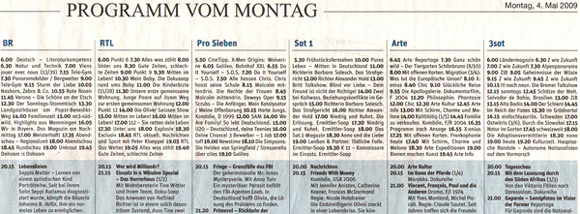
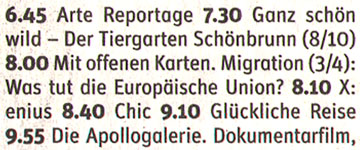
On the one hand I’m always flattered when I see a big German newspaper (Süddeutsche Zeitung in this case) use one of my typefaces. Especially so, when it happens to bring out one of its good characteristics, like being very legible in small sizes on rather coarse paper, as with FF Unit shown here.
suddtsch_unitdetailunit_alternates

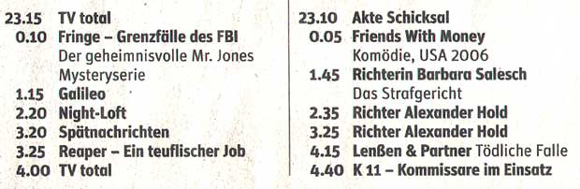
On the other hand I am a little surprised that they would have used the alternate cut, the one with the round a and the single-decker g. That may have been deliberate although I don’t think that the round (Futura-)a is particularly legible. I do have my doubts about the designers’ typographic knowledge. When designing a table like this (and a TV programme is just a table) they must have realized that FF Unit both in the Type 1 and the Open Type version not only provides alternate characters but also a few different sets of figures. For a timetable like this it would have been much better to use Tabular Figures, so that all the hours and minutes would be positioned neatly underneath each other. That does not only look neater, it also makes things more comparable and better to understand in a hurry. The tabular figures in FF Unit still have slight Old Style characteristics, and if that would appear too noisy for some applications, there are Lining Figures as well, also all of equal widths.
sueddttabelle6201tv_programm3

Painted type

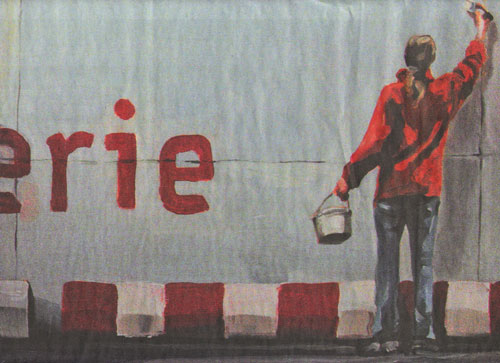
This painting shows a part of the Eastside Gallery in Berlin, a stretch of Berlin Wall along the river Spree. The only substantial part of the wall that’s been left standing because it is covered in pictures. Those get repainted now and again, as the painting by Edward B Gordon shows. In spite of his English-sounding name he is a German painter living in Berlin and has been putting out a painting a day for 900 days now. gordon_painting

There are two reasons why I am showing this here:
1. Gordon’s paintings show the Berlin I know; not always romantic, not always bright, not always flattering, but always observed with affection and painted quickly, before the moment goes away. Great stuff, all Oil on Board, 15x15cm (i.e. 6×6 inches).
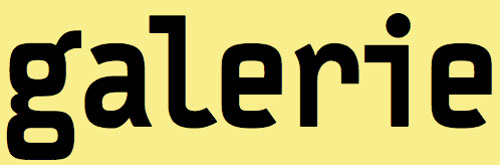
2. Although there are only three and a half letters to be seen, it seems enough to identify the typeface. Five steps away from the original – painted type on wall, painting of that scene, reproduction in the newspaper, scan on my desktop, reproduced on your desktop – I identified it as FF Typestar.galerie

Except for that r. And the i. Seems like whoever painted these letters knew more about type than most graphic designers and certainly used the freedom of the brush to shorten that long hook on the r and the long top serif on the i. A clever solution to avoid a gap that would draw too much attention to this combination.

How we work

The new website for Edenspiekermann is up. A lot of the projects are fairly mainstream and a lot of the copy sounds rather “corporate” to me. That is the result of having to agree on every sentence between nine partners and 100 colleagues. My personal take is represented by the text I wrote about the HOW.

We run our business by sharing responsibility among nine partners. Each of us run project teams. We do not take money from faceless networks and don’t have to be accountable to their controllers. We alone decide who we work for and how we organize ourselves. And we put our money where our mouths are: we are shareholders and interested in the long view.
Most design consultancies or branding agencies (pick your own name) offer pretty much the same type of work. It is how they go about their work that makes the difference. It is a question of attitude, personality, even morals.

The current crisis is also a crisis of values: are people accountable for what they do? Is success rewarded with fat premiums but failure paid for by society? Can we carry on asking for growth as the only way forward? Do we need new values?

Even designers are not only judged by the visible results of their work, but more and more so by how they achieved them. Originality, personality, accountability are new buzzwords. Attitude is more interesting than cleverness.

Brands are successful when they when they are authentic, when they show attitude. They show how they make products, how they treat their people, how they look at the future. Cheap stuff – the What – will still be made in China and elsewhere. Complex processes – the How – are designed here.

New website for Edenspiekermann

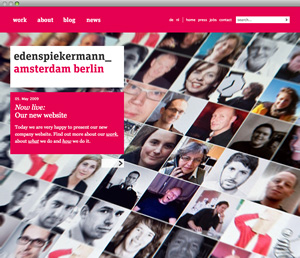
espi_webneu
At 18:00 today (that is 6pm for some people), our new website edenspiekermann went live. We expect a few days of fixing bugs like typos, wrong or missing links, etc. before we start rewriting most of the copy and re-render all the images. Which would all be bad enough if it weren’t for the fact that we have to do everything in three languages and run it by a dozen people at least, in Amsterdam and Berlin.

If you want to know how the site was built, find glaring mistakes or have other suggestions, write to us. The blog has comments enabled.

Proofing press upstairs

My new Korrex proofing press weighs 460 kilos (approx 600 lbs). Getting it from the street to the workshop on the third floor was an adventure which, unfortunately, remains undocumented. Once upstairs, however, our little Flip video camera was at hand to record four grown men and one press in various stages of deconstruction. The movie is very much in beta. A proper version will be made once we can actually pull proofs on the press.
korrex_web