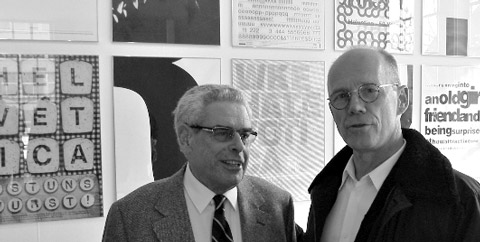
Here is an interview I gave to Eric Karjaluoto from ideasonideas. You can read it below.
EK: Thanks for joining us today Erik. At smashLAB we’ve often admired your work. Needless to say, we’re happy that you are joining us for this little interview. I have certainly struggled with the sometimes divergent demands of running a design studio and working within it, and I believe that many of our readers have likely experienced the same. As such I’d be interested to hear about what you’ve learned, and how you run SpiekermannPartners.
It strikes me that you truly love design. As such, I wonder why you invest so much time in a business. Wouldn’t it be more enjoyable to downsize, hire a couple of assistants and have more time to do the work itself?
ES: I tried that when I left MetaDesign in 2000. But clients either thought I was still with that company 5 years later, or they thought I was too expensive for smaller projects, or they didn’t want to insult me by offering small projects. I would have been very happy designing book covers and other small stuff in an office with 2 or 3 people. But soon after I set up on my own with Susanna, my wife, I got enquiries from big companies again and had to hire other designers…
EK: Some describe me as a workaholic. When my wife and I moved in together this created some challenges. You seem to always be working and rarely are in one place for any length of time. (The other day I noticed that you post your itinerary in your email signature.) In light of these demands, how do you make time for those you love? Additionally, do you have any tips for those struggling to manage their time better?
ES: I have a bad history of neglecting my private life. One of the main reasons my first wife divorced me was the fact that business always took precedence over anything else. I have often had to leave her and my son in the middle of a vacation and go to see a client. In the end, I didn’t even have vacations anymore. Today I actually cancelled a trip to Korea to see the complete senior management of a big client there because my son and my grandson will be visiting me during that week. This is the first time I’ve ever done that, and we may lose the contract.
EK: Your firm has groups working in different locations across the globe, which would seem difficult to manage. Can you tell me a little about the how you track projects? Do you employ any software or project management systems that make this easier?
ES: We have a pretty good extranet and very efficient servers. We can log onto our VPN from anywhere with a fast connection and work off the servers. But it still needs people contact, both with clients and amongst each other. That’s why I travel so much.
EK: Budgets seem like a universally difficult topic for designers. I believe that the (often inaccurate) perception of design as “close to art” makes us squeamish when talking about money. If a company came to you needing a corporate identity system and website, what kind of ballpark budgets could they expect to find?
ES: Anything from 60k to 500k. If I write a proposal, clients will argue money with me, using that “artist” argument. So I get all the proposals written by project managers, and they get away with 30% more than I would. Amazing.
EK: What mistakes did you make at MetaDesign and how have they shaped how you run SpiekermannPartners?
ES: Too many to count. I certainly gave too much power to my new partners who had no experience in the business. I also didn’t always communicate what I was doing, why I was away so much or why a certain conference or presentation was important. In the end, they thought all I did was look after my hobbies. Now that I’m gone, Meta survives mainly because it’s a big brand. Maybe some people have finally understood what it takes to build a big design brand.
EK: The last time I checked, your firm was at 40 members and growing. How do you ensure the quality of work remains consistent? Additionally, how much “Erik Spiekermann” do clients get when they hire SpiekermannPartners?
ES: We’re not quite that many, but almost. Clients get my initial input and my involvement all the time. I am very quick to understand the issues and I am also pretty good about delegating the design work after we have identified the way to go. I look at all the presentation, and I usually present the most important phases myself. But the main thing is to hire good people who are better at some things than I am. And you have to understand that delegating means giving up. You cannot let a team work on a project for weeks without ever seeing what they’re up to and then, at the end, tell them that their work sucks. My former partner used to do that, and in the end, nobody wanted to work with her anymore.
EK: How do you illustrate the value of SpiekermannPartners design solutions to clients? Or, does your recognition in the community allow you to tap into a client-base that is already aware of such value?
ES: No. You always have to tell the same story. Especially when you won’t do pitches. We never do unpaid creative work, but sometimes it takes more time and trouble to convince them than to do the work. But it’s a principle. We often have clients come back after they initially hired somebody else, because they were cheaper or did a free pitch. In the end we know that our approach is better for the client, but they need to find out for themselves sometimes.
EK: You direct a relatively large design firm. With such an organization, the burn-rate on cash often forces principals to look for more lucrative work to sustain the firm’s health. Which clients do you find to be the most profitable to work with? How do you prospect such groups?
ES: Big, long-term projects are best because you get up to speed with it and start making economies of scale. They are boring, but good cash cows. You also need small, interesting projects to keep the designers hungry, even if they lose money. A balance is important.
EK: Professional services firms are usually challenged by the paradox of billable hours. Often, the design solution has a disproportionately great value compared to the time worked. As such, some agencies have proposed the notion of “licensing” ideas. Do you still bill on the hour, or do you have an alternate method of charging for your services?
ES: We always stick to our proposals which are based on time spent. If we take too long, we lose, if we take less time, we win. We do make licensing deals for exclusive typefaces, and we have some jobs with bigger clients that are entirely charged on an hourly basis, but only after a long relationship, where they know they can trust you. Clients can have access to our extranet and the time-sheets if they demand it.
EK: Many firms reference industry erosion, limited budgets, difficult client relationships, and a myriad of other issues as obstacles to strong design solutions. What do you feel stands in the way of your firm doing even better work?
ES: Young, know-all MBAs who avoid risk because they don’t want to endanger their career prospects. In the end, they do endanger their careers by becoming totally interchangeable.
EK: Often it seems that strong designers find difficulty in directing others. Are you a good manager? What lessons have you learned about this aspect of your business?
ES: I am good at inspiring other designers. I am not very good at the daily aspects of running a business. That’s why I have other people who do that for me. I’m best when I improvise, which makes it difficult for our people sometimes to work with me. I’m a Gemini and German: always on time, but sometimes a year late.
EK: Aside from the obvious reasons, such as portfolio and past experience, what do you look for in the designers you hire? Is there a particular characteristic that you find in those who excel at SpiekermannPartners?
ES: Attitude. Curiosity. And at least one skill that is particular to that person.
EK: What is the culture at SpiekermannPartners? How do you maintain this spirit as the organization grows?
ES: Leave people to do what they do best. And provide the best espresso machine in the street, the fastest servers in the business and the most comfortable chairs.
EK: What aspects of your personality are liabilities to your business? How do you overcome these weaknesses?
ES: I tend to lose interest quickly. My boredom threshold keeps going lower over the years. And I’m not really interested in money. Clients sense that. I also can hardly ever say no. Not to interviews, presentations, lectures, big projects, favours, time-wasters, public duties, freebie projects.
EK: Does the “business” aspect of your practice enhance or diminish your capabilities as a designer?
ES: Without it, I wouldn’t be around as a designer. I started a few businesses (like MetaDesign and FontShop), and they’ve all been successfull. You also have to design a business, and that process is very much like working for client projects.
EK: Do you employ others with strong traditional business skills to help plan and manage the growth of SpiekermannPartners? If so, can you tell us a little about the roles they fill and what you gain from these relationships?
ES: We have a freelance controller, 2 project managers and an office manager. They look after proposals, the day-to-day running of the business, our efficiency. I still tell them what equipment we’ll buy and who we should hire and when.
EK: You are highly regarded in the design community, which is quite nice to see given how pragmatic your work is. I don’t believe I’ve ever seen you rely on sensationalism or shenanigans to build your reputation. However, does all of this press and attention result in more–or better–work for you and your firm?
ES: Not really. Clients are hardly ever part of our design scene. But it makes me feel good being liked by most of my peers. I have many friends in the business, and we see each other more as colleagues than as competition. I need that moral support.
EK: Thanks once again for the interview. In closing, are there any last thoughts that you might like to share? Or, do you have any suggestions for designers considering starting their own firm?
ES: Just the usual: do what you’re good at and avoid what you’re not good at. Don’t talk about stuff you do not know about. Even harmless clients will have a bullshit detector and know when you’re out of your depths. Travel and learn. And ask whenever you don’t know something. It is my greatest fear to die stupid.