Just caught on online interview about webfonts and copied this snippet which mentions the fact that preparing fonts for the web is a lot of work.
typekit_on_fontfont
Here is the whole interview:
https://5by5.tv/bigwebshow
Learning from La Vegas
My column in Blueprint magazine always covers the main topic of the issue. This time they asked me to write about Las Vegas.
Las Vegas is a cartoon of itself, a standing joke, but without the slightest hint of irony, or self-distance. It is perhaps the most American of US cities, built evidence to the fact that bigger is better and that better is bigger. Nothing in Las Vegas started as an original idea, and nothing seems older than 10 years, but the sheer amount of borrowed images makes the whole totally incomparable.
In their 1972 book, Learning from Las Vegas, Robert Venturi, Denise Scott Brown and Steven Izenour argued that there was meaning in a place that their peers had scorned, in this case the hotelcasinos, parking lots, and enormous neon signs of the Las Vegas Strip. For them, this place heralded a new but perfectly legitimate aesthetic, one that we needed to study to be ready for the future. What trickled down from this theory to us graphic designers was a new style: The Vernacular.
Certain artefacts are not attributable to an artist, a designer, or an architect. I had always referred to those as apocryphal. Not anonymous, because the authors were known, but the results of their labours were not deemed worthy of a credit. What has been called secondary architecture is mostly apocryphal and responsible for the look and feel of our cities way more than ‘real’ architects would like to admit. Apocryphal work by publicly employed architects and designers ranges from street lights to bus stops, park benches, transformer kiosks and sewage works to paper forms, wayfinding systems and the corridors of hospitals and other public buildings. Work by these uncredited authors does not have to be inferior to that of celebrated artists, it is the conditions under which the work has been done that is different. A city architect will not get sued if a building he planned collapses. Not even his administration will get blamed, as they usually manage to find an outside supplier who will answer for any mistakes or shortcomings. By the same token, he will not have his name in the press, nor engraved on a brass plate. Lack of consequences, good or bad, seems to deny those projects that final kick, as if the designer simply could not be bothered to stay a little longer, try a little harder and fight for his concept.
Vernacular design just exists. It doesn’t win prizes nor get discussed by critics or praised by clients. We have always had a soft spot for the hand-painted signs for barbers in Africa, hand-written menus in little local restaurants and lovingly arranged gnomes in suburban gardens. But after ‘vernacular’ had become a household word in the Eighties, professional designers started exploiting naive ideas and images for their commercial work. Letters from handmade signs were scanned and made into designer fonts, overalls worn by railway workers became trendy city chic and the garden gnomes became part of postmodern architecture.
While you could look at this transfer of no-name designers’ work into the professional mainstream as straight-forward, inexcusable exploitation, you could also argue that it takes us out of our ivory towers and puts us back in touch with ordinary peoples’ aesthetic. Perhaps we can learn something from those who may have no ambitions to change the world of design as we know it, nor formal training. They probably wouldn’t even use the word ‘design’ for what they do. They just draw plans, paint signs and type on keyboards, using whatever software or fonts come with their cheap machine. We could learn that design, architecture, even art depends on natural talent as much as on academic training. Vernacular design also seems to work fairly well without knowledge of all the constraints and rules we are taught at schools and universities. I am not proposing that self-taught engineers start drawing up plans for nuclear power stations or that administrative assistants write and lay out forms for social security applicants. (Come to think of it, that’s what most of those forms in most countries look like.)
I do remember the one thing that attracted me to the vernacular: the joy of achievement that spoke through a lot of that work. Not because they were aware of having solved a major problem, saved humanity from starvation or reinvented their respective disciplines. But having witnessed an artifact made where none had existed before, the laypersons, the apocryphal designers, probably enjoy the results of their efforts more than we professionals do with all our knowledge of what went wrong, how good it could have been and how misunderstood our true genius generally is.
That brings me back to Las Vegas: nothing there will win a design prize. No building, no gaming console, no graphics. But millions of visitors come to the city that has no reason to exist, other than offering an uncomplicated way to get older by a few hours or days, while taking away our superfluous cash. Cheap weddings and divorces in a place that manages to quote all the styles ever built seems enough to attract more people than all the modern art museums ever will. Perhaps even now and again we need to go to Las Vegas to eat some humble pie.
Glasgow ’99 Typeface
A colleague wanted a copy of the logo for Glasgow ’99 that we designed at MetaDesign London back in 1997. When I looked for it, I found the movie that we made for the presentation at the time. Made in Director, not Flash, it is already a historical document.
Glasgow Typeface from erik spiekermann on Vimeo.
An interview with Erik Spiekermann by Adrian Shaughnessy — Part 2
This is the second part of the interview with Adrian Shaughnessy. The first part was here.
What sort of designer had you become at this point?
Well, I’m not a very good designer; I’m an OK designer. I’m OK when it comes to complex things like grids. I like maths. I like geometry. I like multiples. How things are arranged on the page. I like that because it’s all about discipline. I learnt about type through doing hot-metal typesetting. So I know that what is between the black marks is as important as the black marks themselves. With metal typesetting you have to touch it, it’s not just the return key. So that’s my discipline. I’m an art historian by trade; I’m slightly intellectual, maybe too intellectual. When it comes to visualizing things I’m too intellectual, it becomes too obvious. Neville Brody’s the exact opposite of me. We’ve worked together successfully. Neville’s a digital painter. He just throws it on the page and it looks great, but he can’t repeat it. I’m the other way round. I provide the skeleton, I make sure things don’t fall down. And he makes it look good, and I’m very happy with that.
When I set up my studio somebody said to me, ‘always employ people better then you’. It was the best advice anyone gave me. But I resisted it for a long time. It was hard to accept.
As a mediocre designer, I realized that I could look much better if I had good people. And because I’m good at certain things (I’m pretty good at type, especially the mechanical part of type, and I have a good knowledge of the historical), I can afford to hire good people. Some people are afraid of hiring better people but I’ve never been like that because actually it makes me look good. So the system was always that I’d hire really, really good people and let them do their shit.
That’s the good thing about a large studio. If you had two or three people it is difficult because then you have the egos. When you have 20 or 30 people that evens things out. Also, the one thing I like about having more than 100 people, or more than 70 people, is you suddenly have this little grey area where you can hire two or three people who haven’t really got a job description because it doesn’t really matter. I hired this American programmer who I never told my partners about. He was doing database programming and C++ in the late 1990s before that really became a necessity, before we had PHP. I hired him because we could afford to.
I had another guy who was a conceptual person. He had no training whatsoever but he was just bright in a slightly weird way. You couldn’t put him in a group of people. But you could feed him shit and he’d come out with this amazing stuff. Never to a schedule, never within a group, but I loved the luxury of having these guys who just prance about with bells on their caps. In a small studio you can’t afford that.
Designers want to be credited for their best work. What is your view on credits?
I always give everyone a credit and make sure that everybody is in the bylines. I know how important it is to be able to say ‘I worked on this’. I don’t mind listing ten names in a credit. If the client lets me, I’d put Edenspiekermann, and then list the five or six people who worked on the team. Those people can put this work in their portfolios without lying, or pretending. I’ve seen portfolios that people have presented to me containing work done by me. They weren’t even there. Forgery has become so easy, so if you give somebody a credit, it’s out in the open. Of course, a lot of clients won’t let you. We have quite a few clients who will not allow any credits whatsoever, which I find very, very difficult. Also credits are not only there for your CV, it’s like applause. Designers need applause, they need to be praised and I like praising people.
What do you look for when hiring a designer?
They have to know something really, really well. Something they’re really good at. If somebody’s good at C++, or someone’s really good at drawing, it doesn’t matter what it is, they just have to have one speciality. Also, they have to have general knowledge. I hate people who don’t read. I hate people who don’t cook, or don’t know anything about music.
I couldn’t work with anyone who only goes to McDonalds. I want people who know movies, who know music, who read books. As you know, not all graphic designers are ‘multidimensional’. They don’t read, they don’t do anything else, and I couldn’t work with those people. I need team people who have general knowledge because that’s what we do, and I want those freaks who can do one thing that nobody else can do.
You touched on the importance of physical space with your diagram. What about internal details – does the furniture, the monitors, the shelving have an impact on creativity and efficiency?
Oh yeah. There are three or four major issues. The first is how you feel while you are working. I spend a lot of money on chairs. We couldn’t save anything there because we spend 10-12 hours a day at work, and it’s our health. At my age, I know what a bad chair can be like. Best chairs, best lighting, best desk, best equipment. I won’t buy crap and I won’t buy illegal software. I couldn’t always afford the best furniture, but as soon as I could, I bought the best for my people. It doesn’t have to look chic. I don’t mind Ikea tables. They’re fine as long as the y’re the right height and they have the right surface. I want to have best tools, which for me always included great espresso machine, clean toilets, good drink, decent water, that sort of stuff.
The second issue is that it is not necessary to set out to impress clients. We don’t need to show off. We don’t need marble staircases; we don’t need receptionists who constantly file their nails. But we need to show that we care.
The third part is the communal part of it. I want a space where people know what’s going on. I want transparency and if we have a meeting room like the one we are in right now, with glass walls, we have transparency. But it’s still sound-proof. You do certain things that need to be conducted out of earshot. Someone’s review, for instance.
So privacy is necessary, but you want people to see that essentially you have your hands on the table.
Does location matter?
That’s the fourth factor. It’s important that the space is somewhere everyone has an easy time getting to. Here in London you could probably get cheap office space out of the centre, but if you want people to get to it easily, it has got to be in the middle of the city. The precise area is important too. People need to get out. They need to buy lunch for three or four pounds/dollars/euros, or whatever, and they also need to see other people. That’s really important, that’s why we get stuck in fairly expensive places. We need to be where it buzzes. You also need to bump into peers and colleagues. Wherever I go, even in London where I haven’t lived for almost 20 years properly, I still bump into people I know. If I go to a bookshop I bump into people I know. I go to a pub or a restaurant and I bump into people I know. This is important.
So – a studio with good furniture, in a good urban location, near the centre of things. Anything else?
I always go round trying to tidy things. I’m not tidy myself. I’d like to be, but I fall behind like all of us and end up getting piles of paper on my desk. Then I get panicky and I file things into folders. I hate messy offices. I want clean toilets. I won’t have posters all over the place. I won’t have crappy notices next to the toilets; that annoys me. We don’t print out stuff in Comic Sans, and even our office people in Berlin know that when they print out a notice they must use our studio typeface.
Should every studio have its own typeface?
I’ve always designed the typeface for every studio I’ve had. Always. It’s easier for them to remember which one to use. I designed Unit for United Designers and now we have Espi for Edenspiekermann, and of course Meta had Meta, which I designed for them.
Do you think it’s necessary for studios to socialize?
Yes, very important. We have a major crisis in Berlin at the moment; there’s hardly any work. Some of the freelancers know they probably will have to go soon. The employees, the people on payroll, also know that it’s getting tough. Everyone’s getting cut down by 30%, and you can’t just send people an email telling them this. You’ve got to have a get-together.
We have a tradition, when somebody has a birthday they bake a cake or they bring in a cake. Some buy it, some bake it. Now that we have 30 people, that’s a birthday every other week. So there’s a little email saying ‘cake in the kitchen’. Everybody knows, ‘oh it’s somebody’s birthday’. These things are important for team-building and loyalty-building. We have our Christmas parties, and we have our summer parties in between our picnics. We don’t go over the top. We don’t hire people to plan our parties. But I think they are important.
You’ve worked in and visited studios all over the world. Do studios exhibit national characteristics?
I’ve always been fascinated by how studios look different in different countries. Everybody in London works in spaces that we wouldn’t even go into. Where British studios have eight people, we’d have two. You work in spaces that are incredibly small. My designers in Germany would just say ‘you gotta be joking, there’s no way we’ll work there.’ And they’d probably call some Office of Environment Administration and they’d come and close you down because you are treating people like battery hens. Or you go to Tokyo and they work standing up. Why do Americans love partitions? They love their reception areas, and having their work on the walls. You walk into a lot of American consultancies – design studios or whatever you want to call them – and they look like advertising agencies. And in our case – in Germany – it’s much more clinical. It’s much more like industrial design. In the UK a lot of studios look more like artist’s studios; Britain is still very art-based. British design studios never have a reception area. You always walk straight into the studio.
The full version of this interview can be found in the book Studio Culture: the Secret Life of the Graphic Design Studio, edited by Tony Brook and Adrian Shaughnessy, published by Unit Editions. The book is available to AGDA members at www.uniteditions.com
From EYE magazine
Text by Liz Farrelly
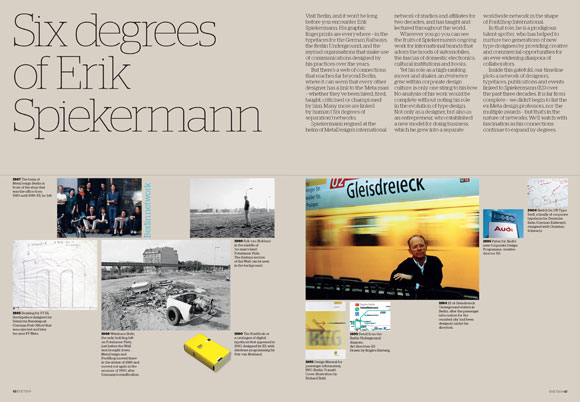
Visit Berlin, and it won’t belong before you encounter Erik Spiekermann. His graphic fingerprints are everywhere – in the typefaces for the German Railways, the Berlin Underground, and the myriad organisations that make use of communications designed by his practices over the years.
But there’s a web of connections that reaches far beyond Berlin, where it can seem that every other designer has a link to the ‘Metaman’ – whether they’ve been hired, fired, taught, criticized or championed by him. Many more are linked by human (‘Six degrees of separation’) networks. Spiekermann reigned at the helm of MetaDesign’s international network of studios and affiliates for two decades, and has taught and lectured throughout the world. Wherever you go you can see the fruits of Spiekermann’s ongoing work for international brands that adorn the hoods of automobiles, the fascias of domestic electronics, cultural institutions and books.
Yet his role as a high-ranking mover and shaker, an éminence grise within corporate design culture, is only one string to his bow. No analysis of his work would be complete without noting his role in the evolution of type design. Not only as a designer, but also as an entrepreneur, who established a new model for doing business, which he grew into a separate worldwide network in the shape of FontShopInternational. In that role, he is a prodigious talent-spotter, who has helped to nurture two generations of new typedesigners by providing creative and commercial opportunities for an ever-widening diaspora of collaborators.
Inside this gatefold, our timeline plots a network of designers, typefaces, publications and events linked to Spiekermann (ES) over the past three decades. It is far from complete – we didn’t begin to list the ex-MetaDesign professors, nor the multiple awards – but that’s in the nature of networks. We’ll watch with fascination as his connections continue to expand by degrees.
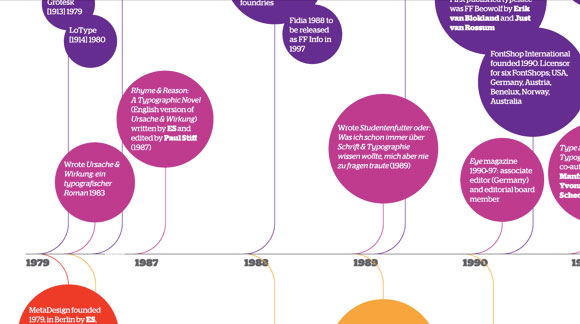
You can download the timeline here.
The article is online at eyemagazine.
Treble-trouble
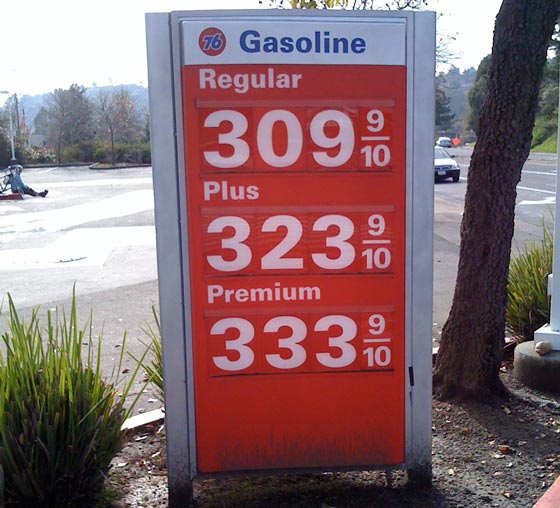
Human capacity to make mistakes is unlimited, as Murphy formulates in the eponymous law. Bill Hill sent me this picture from California. The figure 3 appears six times. Why are the bottom figures upside down while all the others are the proper way round? Does the person who put the figures on that sign know something we type designers don’t know?
German Rail, before/after
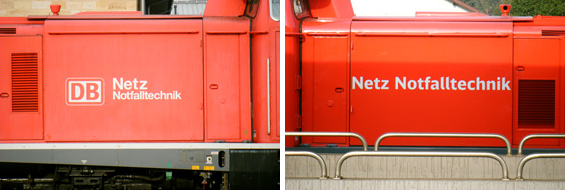
This comparison is a little unfair. The locomotives of the former Bundesbahn (Federal Railways) were painted in a raspberry colour which obviously didn’t age too well. The new engines are painted bright red. We don’t know what this colour will look like in 20 years’ time. But the Bundesbahn’s Helvetica type hasn’t aged well either. It is far too tightly spaced and anything but specific. Using DB Type, Deutsche Bahn’s exclusive typeface, signifies ownership so clearly that there is no need for a logo. Red and type are enough to brand the locomotive.
The science of chocolate
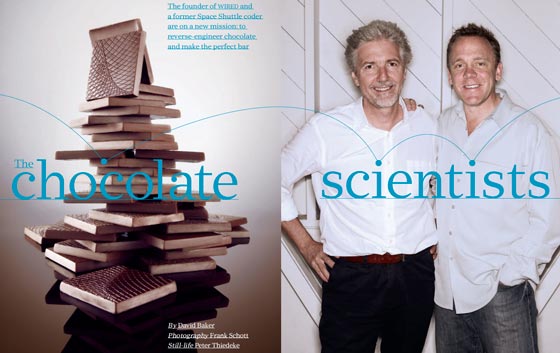
I’ve been involved with TCHO, chocolate makers in San Francisco, as a designer and an investor, for a few years now. Susanna Dulkinys, my wife and business partner, has won several prizes for her work on the TCHO brand and packaging. We have been interviewed about the design aspects, shown the project at conferences and talked to other clients about it. The story of how this amazing chocolate is actually made and why it’s different from other chocolates is told in a feature in WIRED magazine’s UK edition. As it happens, Louis Rossetto, CEO of TCHO, was co-founder of WIRED way back in the early 90s.
For better reading enjoyment, here is a pdf of the article to download:
Wired_022010_Tcho