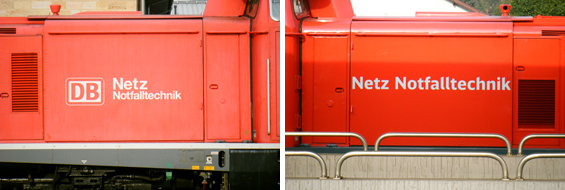
This comparison is a little unfair. The locomotives of the former Bundesbahn (Federal Railways) were painted in a raspberry colour which obviously didn’t age too well. The new engines are painted bright red. We don’t know what this colour will look like in 20 years’ time. But the Bundesbahn’s Helvetica type hasn’t aged well either. It is far too tightly spaced and anything but specific. Using DB Type, Deutsche Bahn’s exclusive typeface, signifies ownership so clearly that there is no need for a logo. Red and type are enough to brand the locomotive.
It’s more legible, but I cannot agree with you that it is enough. It’s jammed in there with no breathing room at all. Would it not be better if the type was stacked with space for a logo on the left? I think so, but you’re the master of type.
I didn’t design this. I just designed the type and the corporate design guidelines. They don’t mention locomotives
I agree with Duncan, the context here botched the otherwise pristine logotype.
Shouldn´t every corporate design guideline dictate a minimum amount free space (e.g. the cap-height) surrounding the logo in any setting? Did they ignore this when they did the decor for the train?
That’s not a logo, it’s a name. And there is plenty free space, it just has lines in it. This is the reality that all corporate design systems have to live with. The point is that even without a logo, the engine is branded, by type and by colour.
I quite like the new treatment. I see the previous points of “crowding” etc; I happen to view the canvas as the entire red face of the locomotive – visually unimpeded by the joints, grates and lines.
I also agree about use of guidelines: “the reality that all corporate design systems have to live with.” Unless a system is designed for a specific application, you can expect certain liberties to be taken in displaying designed elements.
I always lean toward the simpler solution, and for me this accomplishes the larger objective.
I love the after design.