Here’s a video showing how it works. You can get the app from iTunes.
Videos on Vimeo
There are lots of videos about me or by me or by us out there, and not all of them are easy to find. Vimeo now offers this great script that just puts these small previews together, so I thought I make a start with the first four videos that I found and uploaded myself. I’ll try and find more of them. I can, of course, only upload those videos that I have legal access to. The TV stations usually won’t allow that.
Founding FontShop
Stephen Coles interviewed me about the history of FontShop.
ZDF heute German TV news relaunch
Christiane Scheibe Pluriversum made this video featuring the typefaces and icons we designed for the relaunch of ZDF’s heute news programme in 2009. The motion graphics werde done by Velvet in Munich.
From Metaphor to Maturity
This is a piece I originally wrote for my Achtung column in Blueprint magazine. When John Boardley asked me to contribute to his forthcoming magazine Codex, I was too busy to write anything from scratch. As, however, I considered the overlap between Blueprint’s and Codex’s readership to be negligible, I offered this article. John suggested sending him a photography of my infamous bookshelf that runs over two floors in our house in Berlin, where the top shelves can only be reached by strapping oneself into a climber’s harness which is moved up and down by an electrically operated winch.
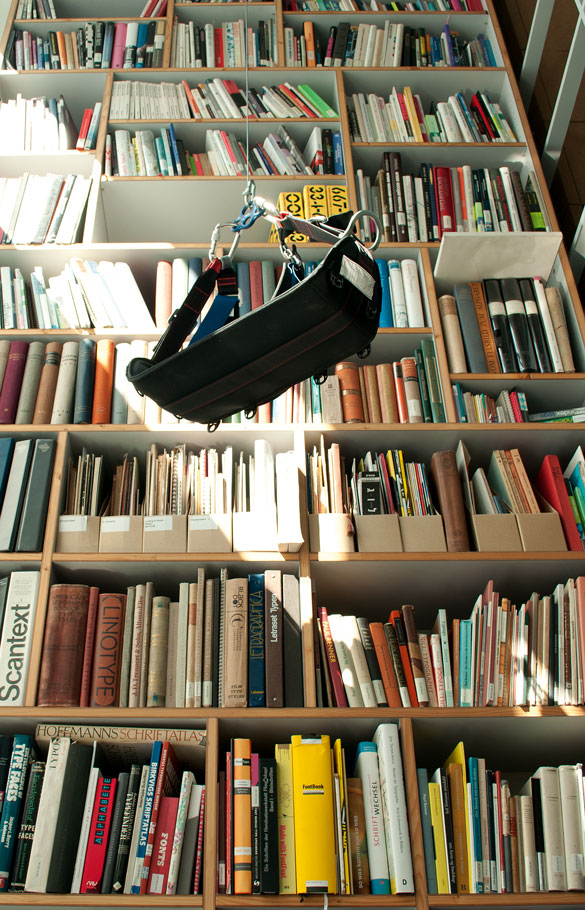
I don’t think John edited my piece very much, but I did notice that he changed my British aluminium to the US aluminum. As you can see below, I would have insisted on my original spelling. No idea why one would ever change that word in the first place – in German word we also write (and say) Aluminium. John did me a favour though: he found the source for the Ovink quote below. Thank you, John, for that and for Codex.
“A typographer who hasn’t found the appropriate typeface may not have decreased the informational value of a text, but gave up the opportunity to considerably increase its effectiveness.”* So wrote G. W. Ovink, Dutch typographer and historian, way back before he knew any other media besides paper.
Every medium has always had constraints for the type that goes with it. Whether you design a newspaper, a poster, a stamp or a website: you have to consider the technical environment, the reader, the client, the content. As the surfaces of substrates used for printing got smoother, the resolution of type went up along with it. If you look at a Gutenberg Bible through a magnifying glass, you’d never believe the craters, bumps and blotches that look like gorgeous letters from a safe reading distance. Bright and shiny, smoothly coated paper for high-quality offset printing requires the letters to be sharp and well-defined, even though the human eye doesn’t like too much contrast. Technology, being what it is – a means to promote itself if not mankind – kept providing more resolution and thus invisible detail than we ever needed. Once printing could hardly be more refined, along came the Cathode Ray Tube, and all the high definition that the suppliers of typesetting and printing equipment had declared not only inevitable but vital, was broken down into crude bits of colour, red, green and blue only. Type suddenly looked like Lego bricks when compared to the refinement a printer like Bodoni had been capable of at the beginning of the 19th century, long before photosetting and offset printing, let alone coated stock.
The web has always just been bad paper. Now it’s starting to look like good paper and designers will have to treat it as such. But as always at the beginning of a new paradigm, we have to imitate the old one while we get used to the new possibilities that those over a certain age always consider a challenge. Apart from what technology will allow us to do, there are physical laws – our eyes, our brain, light, contrast; we cannot ignore those if we want to communicate. Cultural parameters like reading habits, literary culture (or lack of) – our deeply embedded fear of change, all these give an excuse to imitate the old even though there are no technical reasons to do so. But we read best what we read most.
Every new medium raises the same questions. Things which were thought mature in one media will take a while to mature in a new one. Look at the new electronic books, particularly those on Apple’s amazing iPad: a book is presented as a reproduction of the traditional stack of bound pieces of paper. Going from one page to the next is accompanied by an animation of it being turned, even with the sound of paper being rustled. While you keep thumbing pages, however, the stack stays equally thick on either side, turning the metaphor into a lie, into digital kitsch. It feels wrong and it is wrong. Metaphors are useful because we do not really want to know what goes on in the digital maze under the bonnet that the operating system hides. Superfluous visual noise doesn’t make the reading any easier, it just presumes that we’re too stupid to notice the difference between a stack of glued paper and a battery-driven piece of plastic. If people really wanted to emulate the whole physical experience, why not give us the musty smell of old books, the scent of printing ink?
Worse than those misguided and patronizing metaphors is the fact that publishers can no longe decide which typeface their text is set in. Apple provides just five (Baskerville, Cochin, Palatino, Times, Verdana), and only one of them (Palatino) can be considered a book face suitable for reading on a screen. Somehow, the dichotomy seems weird between cool aluminium shapes, high-tech displays and amazing technology on the one hand and wooden bookshelves on the other, as a metaphor for an online bookshop which provides books that look older on screen than they do in the real world. Perhaps the individual design departments responsible should talk to each other? Or does Steve Jobs not have such great taste after all?
Still, while electronic books have a way to go (the Kindle is actually a little further ahead in typographic matters), there are signs that the web will soon allow the same degree of typographic refinements that we’re used to on traditional paper. Not only can we use every existing typeface to be displayed in a browser, but new mark-up languages will give us typographic treats like ligatures, small caps and old style figures that printers in the 15th century developed for their books that we still consider benchmarks today. If only somebody could invent a battery that lasted as long as paper does.
* Ovink, G. W. Legibility, atmosphere-value and forms of printing types. Leiden: A. W. Sijthoff, 1938, p. 177.
Rip-off explained
MyFonts obviously have no quality control whatsoever. Or they would have noticed that the typeface they published under the name Silkstone was not only a blatant imitation of my ITC Officina, but that even the data is bad.
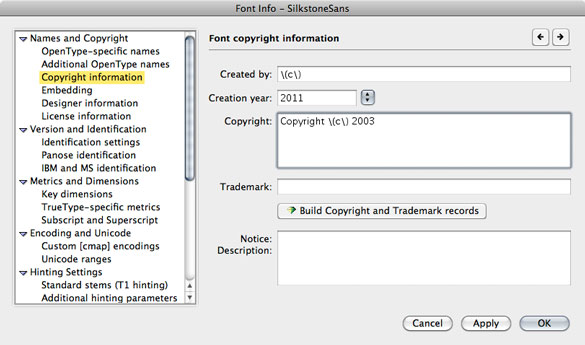
The copyright field in the font information shows no credit, but the perpetrator didn’t even bother to delete the date which shows when the original version was released, in this case 2003. (There have been various updates and new versions of Officina since its original release in 1989)
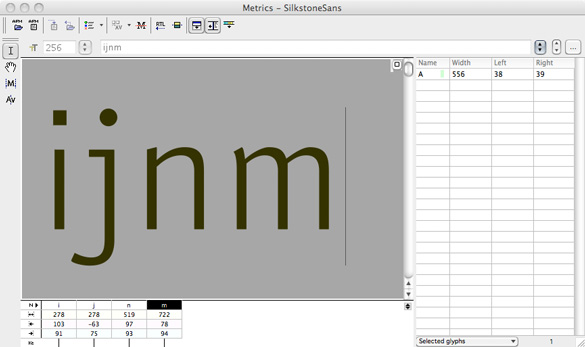
In order to either hide the source at least a little bit, a few letters were changed, e.g. the dot on the i was made square and the serif removed. But the j is the give-away: surely those changes should have also been applied to it as well? The same applied to the n and m. A little manipulation here, none there.
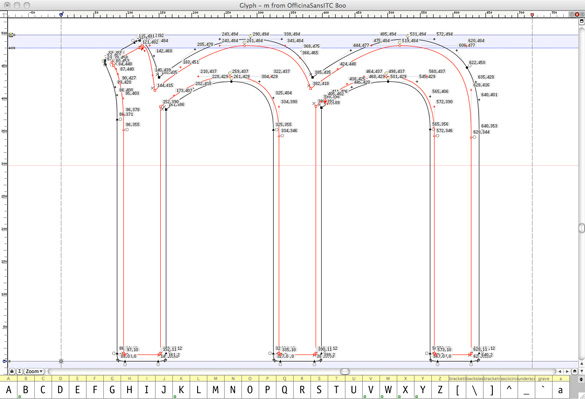
And, finally, this is how it was done: the complete font was extrapolated automatically, probably to make it look different. The result is a thinner and smaller letter (the red outline), with bad data where the automatic procedure would have required manual intervention to make it good. Obviously too much trouble for someone who’d rather pretend to be original than to actually do original work.
Elegant styled new typeface?
A new typeface that is introduced with such bad grammar (it should be “elegantly styled…” and “sophisicated” instead of “sophisticated” is a dead give-away) is off to a bad start. It only takes one look to see that this description
… The Silkstone Sans font was originally created to fill a void in the typeface market and is aimed at people looking for a classic elegant styled modern typeface suitable for a vast array of projects and designs. Designed and produced by Paul O’Connell of POCT, it is a sans serif typeface created with many flavours and influences, but still manages to retain its originality and is a tribute to many of today’s modern fonts …
is a load of bollocks. Silkstone Sans is an unashamed rip-off of my ITC Officina. Raising the crossbar on the e a little and straightening the top left on the n hardly constitutes a redesign (the m has been left alone), neither does extrapolating the face to a thinner weight. Making the i-dots square instead of round and taking the serif off the i takes away some of Officina’s strong character without adding originality, so why bother?
I am surprised that no-one at MyFonts saw this. It didn’t take very long after its release that lots of people saw it, recognized the deceit and tweeted about it. I am surprised that Paul O’Connell has had the nerve to so publicly expose his lack of shame. Or has stealing someone else’s work suddenly become something to brag about?
The original: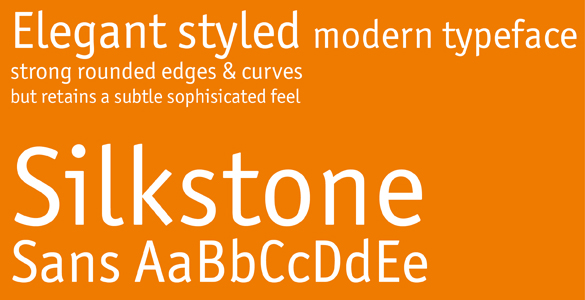
The fake: 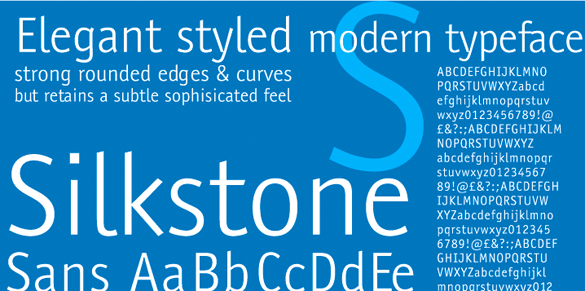
Art Bollocks Generator
I clicked the button on Art Bollocks Generator which came up with this:
My work explores the relationship between emerging sexualities and life as perfomance.
With influences as diverse as Wittgenstein and Frida Kahlo, new synergies are crafted from both simple and complex meanings.
Ever since I was a teenager I have been fascinated by the ephemeral nature of meaning. What starts out as triumph soon becomes corrupted into a hegemony of temptation, leaving only a sense of what could have been and the possibility of a new reality.
As spatial impressions become frozen through boundaried and personal practice, the viewer is left with an insight into the possibilities of our future.
That wasn’t arty enough, so I pressed the generate button again and it gave me this:
My work explores the relationship between new class identities and multimedia experiences.
With influences as diverse as Nietzsche and Roy Lichtenstein, new combinations are created from both simple and complex meanings.
Ever since I was a child I have been fascinated by the ephemeral nature of the mind. What starts out as hope soon becomes corrupted into a cacophony of temptation, leaving only a sense of chaos and the inevitability of a new synthesis.
As temporal phenomena become frozen through boundaried and diverse practice, the viewer is left with a glimpse of the possibilities of our future.
Click again, and this was offered:
My work explores the relationship between emerging sexualities and skateboard ethics.
With influences as diverse as Nietzsche and Francis Bacon, new tensions are crafted from both traditional and modern layers.
Ever since I was a child I have been fascinated by the theoretical limits of meaning. What starts out as hope soon becomes corroded into a cacophony of lust, leaving only a sense of chaos and the possibility of a new reality.
As shifting forms become clarified through emergent and critical practice, the viewer is left with an impression of the edges of our future.
Year Zero?
I have just returned from the OFFF festival in Barcelona. Earlier this year, they asked me for a statement about the future. They announced this the Year Zero, a restart. Go back to zero, wipe out the past, etc. Not sure I agree with that, but that’ll be the topic for another comment.
Usually, I deny these requests because I don’t like making predictions about subjects I don’t know. But they insisted, and in the end I sent them this little piece:
Rethink Design, Redesign Thinking.
As a designer, I like the future.
After centuries of being dominated by technology – from cutting wood to printing negatives, from baking mud bricks to reinforcing concrete – designers of all disciplines now have the tools to present and make anything imaginable. There is no excuse for not coming up with new concepts. Designers and architects can no longer blame their shortcomings on the limits of technology. There will always be clients to blame – that has not changed since the Pope asked Michelangelo to paint the ceiling of that little chapel in the Vatican.
The best thing, however, is the fact that we are beginning to realize something else: we have talents that go beyond making things work well and look good. We can also take apart ideas, look at them, throw away what is not needed and put them back together again. Designers can redesign thinking. And we need to, because nobody else will.