In einem Interview online über Webfonts habe ich gerade diesen Ausschnitt gesehen und kopiert:
typekit_on_fontfont
Hier das ganze Interview:
https://5by5.tv/bigwebshow
All posts by erik
Eine Schrift für Glasgow ’99
Als ein Kollege das Logo haben wollte, das wir bei MetaDesign London 1997 entworfen hatten, fand ich den kleinen Film, den wir für die Präsentation 1997 gemacht hatten. Nicht Flash, sondern Director – schon ein historisches Dokument.
Glasgow Typeface from erik spiekermann on Vimeo.
Ein Interview, nur auf englisch, 2. Teil
Dieses ist der zweite Teil des Interviews mit Adrian Shaughnessy. Den ersten Teil gibt es hier.
What sort of designer had you become at this point?
Well, I’m not a very good designer; I’m an OK designer. I’m OK when it comes to complex things like grids. I like maths. I like geometry. I like multiples. How things are arranged on the page. I like that because it’s all about discipline. I learnt about type through doing hot-metal typesetting. So I know that what is between the black marks is as important as the black marks themselves. With metal typesetting you have to touch it, it’s not just the return key. So that’s my discipline. I’m an art historian by trade; I’m slightly intellectual, maybe too intellectual. When it comes to visualizing things I’m too intellectual, it becomes too obvious. Neville Brody’s the exact opposite of me. We’ve worked together successfully. Neville’s a digital painter. He just throws it on the page and it looks great, but he can’t repeat it. I’m the other way round. I provide the skeleton, I make sure things don’t fall down. And he makes it look good, and I’m very happy with that.
Continue reading
Aus der Zeitschrift EYE (nur englisch)

Text by Liz Farrelly
Visit Berlin, and it won’t be long before you encounter Erik Spiekermann. His graphic fingerprints are everywhere – in the typefaces for the German Railways, the Berlin Underground, and the myriad organisations that make use of communications designed by his practices over the years.
But there’s a web of connections that reaches far beyond Berlin, where it can seem that every other designer has a link to the ‘Metaman’ – whether they’ve been hired, fired, taught, criticized or championed by him. Many more are linked by human (‘Six degrees of separation’) networks. Spiekermann reigned at the helm of MetaDesign’s international network of studios and affiliates for two decades, and has taught and lectured throughout the world. Wherever you go you can see the fruits of Spiekermann’s ongoing work for international brands that adorn the hoods of automobiles, the fascias of domestic electronics, cultural institutions and books.
Yet his role as a high-ranking mover and shaker, an éminence grise within corporate design culture, is only one string to his bow. No analysis of his work would be complete without noting his role in the evolution of type design. Not only as a designer, but also as an entrepreneur, who established a new model for doing business, which he grew into a separate worldwide network in the shape of FontShopInternational. In that role, he is a prodigious talent-spotter, who has helped to nurture two generations of new typedesigners by providing creative and commercial opportunities for an ever-widening diaspora of collaborators.
Inside this gatefold, our timeline plots a network of designers, typefaces, publications and events linked to Spiekermann (ES) over the past three decades. It is far from complete – we didn’t begin to list the ex-MetaDesign professors, nor the multiple awards – but that’s in the nature of networks. We’ll watch with fascination as his connections continue to expand by degrees.

Die Klappseite gibt es hier als Download.
Online kann man den Artikel lesen bei eyemagazine.
Drei Drei Drei
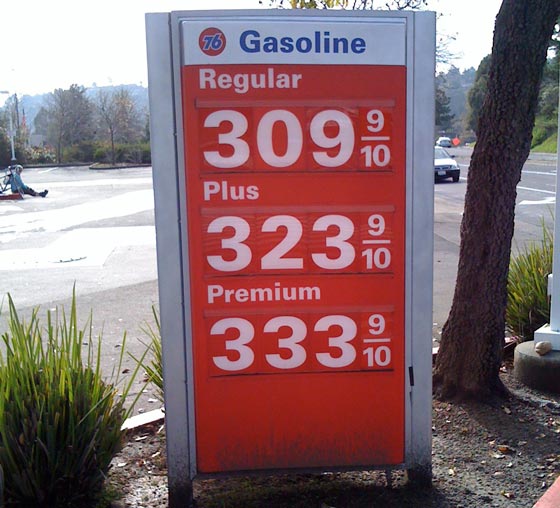
Die menschliche Fähigkeit Fehler zu machen ist unbegrenzt. Auf diesem Tankstellenschild sind sechs Dreien abgebildet. Warum nur sind die untersten drei auf dem Kopf, während die anderen richtig dargestellt sind?
Das Bild hat mir Bill Hill aus San Francisco geschickt.
Deutsche Bahn, vorher/nachher
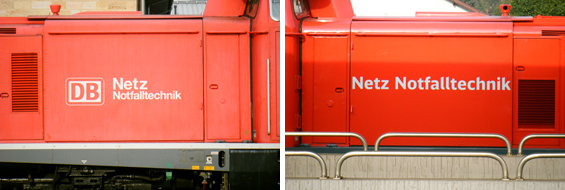
Der Vergleich ist ein wenig unfair: früher waren die Loks der Bahn rot mit einem Blaustich, Himbeer genannt. Ausgeblichen wirkt die Farbe nicht sehr elegant. Die neue Lok ist Verkehrsrot lackiert, knallrot im Volksmund. Wie diese Farbe in ein paar Jahren aussehen wird, wissen wir nicht. Aber auch die alte Helvetica der Bundesbahn ist in die Jahre gekommen: viel zu eng gesetzt und sehr behäbig wirkend. Die DB Type hingegen kennzeichnet die Lok so eindeutig, dass sie ohne Logo auskommt. Rot und Schrift reichen als Markenkennung der Deutschen Bahn.
Die Wissenschaft des Schokolademachens
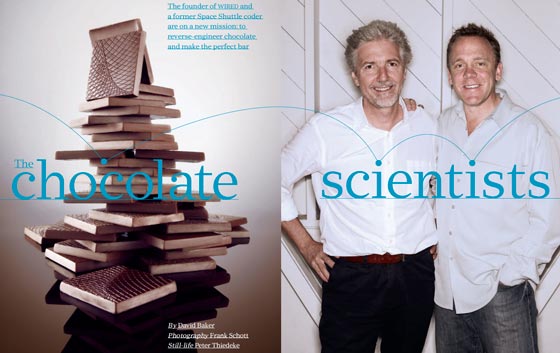
Seit einigen Jahren habe ich mit TCHO zu tun, dem Schokoladenhersteller in San Francisco – als Gestalter und Investor. Susanna Dulkinys, meine Frau und Geschäftspartnerin, hat für ihre Gestaltung der Marke und der Verpackungen etliche Preise eingeheimst. Wir sind zu dem Thema interviewt worden, haben sie auf Konferenzen vorgestellt und anderen Auftraggebern als Vorbild gezeigt. Die erstaunliche Geschichte der Produktion dieser high-tech Schokolade kann man nun lesen in der englischen Ausgabe von WIRED. Wie das Leben so spielt, war Louis Rossetto, Geschäftsführer von TCHO, in den frühen 90ern Gründer von WIRED.
Besser lesen (allerdings immer noch auf englisch) kann man den Artikel in diesem PDF:
Wired_022010_Tcho