Football

The World Cup may be over, but I still get comments about the design disaster caused by the logo and the rest of the corporate design for that event. Check Deutsche Welle www.dw-world.de.

My interview was not my only comment about this design disaster, but the only one in English. Saves me translating all my other comments.

MetaHeadline

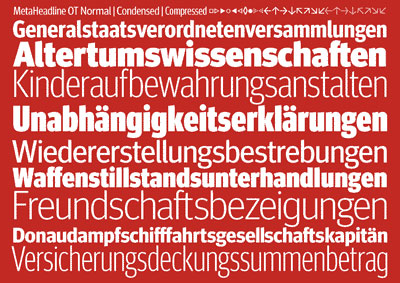
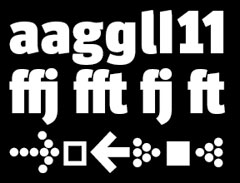
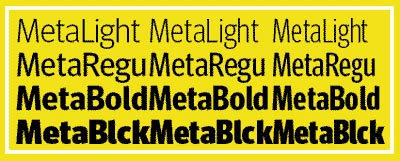
FF Meta’s lively shapes make it look good in small sizes and certainly give it character. Often too much so for headlines. Enter MetaHeadline: three widths with four weights each. For extra tight setting, some characters have alternative shapes.


FF MetaHeadline is now available from your local FontShop.

The sincerest form of flattery?

It’s flattering to know that some of my typefaces have influenced other designers. Except…


.. now and again I see a new face that feels uncomfortable. I still draw letters, but most of the younger designers go straight to the screen. More often than not, they open an existing font and play around with an outline. Which is a good exercise, very much like me tracing over a print in a specimen book, as I did when I first started drawing type 30 years ago. Through constant sketching, eventually without the old original in view, you acquire your own shapes. Working on screen, however, you can hardly ever get rid of the original. Even if you touch every point, the feel of the underlying data will always be there. They ensuing ‘new’ typeface may look different, but anybody with a bit of experience will know what it was based on. Check this specimen and judge for yourself.


This is Textra, released by Linotype.

And this is good old FF Meta, designed almost 20 years ago by myself. I’ve been accused of having put too many silly details into it, like an oblique top terminal on some of the caps, like the E. Now look at Textra’s E.

form condensed, 6

More from my column in form, the German design magazine.

Pitched out
A pitch is the presentation of design ideas to a client by competing agencies or studios.

I keep reading ?(…) won the project (…) after a pitch…? Won? A pitch is the presentation of design ideas to a client by competing agencies or studios. The Americans pitch a baseball, while the English noun denotes a black, sticky substance that is difficult to get off your hands. That stuff is called Pech in German, and we use the same word for bad luck. I love etymology! Bad luck indeed for those who don’t win a pitch. Clients invite designers to a pitch when they think they need help with a communication problem, and the fee usually doesn’t even cover the cost of the colour prints. That would be like visiting several restaurants in a row and trying the food in each one, then refusing to pay the bill because none of the dishes were really to your liking.
Taking part in a pitch where concepts are sold for a fraction of what they are worth, in other words: given away, makes you a loser three times over. First you lose any respect for our business, because if it can be given away, it can’t be worth much. Then you lose money by not being paid for your most valuable asset: ideas and their visualization. And finally, you lose any chance to show the client that it takes a dialogue to solve design problems. A pitch is like a blind date with many partners at the same time. A client who invites designers to a pitch without first talking to them properly, at length and in depth, might as well draw lots among the members of a professional association. And if a client does engage a few designers in a dialogue about the issue, he won’t need a pitch any more. He’ll know who to trust.
Why then do more and more clients think that pitching is the way to go, and why do so many designers take part? It seems that Stupidity, Laziness, Vanity and Cowardice – the four Riders of the Design Apocalypse – drove Reason, one of the patron saints of design, to a blackout; a pitch black one, so to speak.

form condensed, 5

More from my monthly column in form, the German design magazine.

Logos to go.

Who needs graphic designers when you can just get logos online for a few dollars?


At last there?s a colleague who does away with a myth: designing logos and other graphic ephemera is the beginning of an extensive process in which the company first has to ‘find’ itself, before it, aided and abetted by management-, style-, advertising and design-consultants, reaches the apex of Corporate Design: the logo.
I quote from a web site:

“We involve up to 5 graphic designers on your behalf in order to get as much variety of designs as possible. We now offer a new logo design, done by at least 3 different graphic designers, for just 199 Euros.”

There you are: if 1 designer makes a bad logo, 5 designers can make 5 bad logos. One can hardly get a decent meal for that sort of money these days! But there’s more:

“This is a unique offer, well below the common price structure in this business of between 500 or even 2000 Euros.”

Wow! 2000 Euros? Weidemann was rumoured to have been paid 200,000 old Marks for his DB-logo back then. That must have been one percent for the work, with the remainder as damages for countless presentations, corrections and re-submittals over the course of the two years, the usual time span these things take in a government agency.

“Why are our prices so low? Our designers work from home. Our services are based on communication via electronic media between designer and client: e-mail, SMS, Chat, Internet. And our designers work in economically well-placed regions.”

So there. While they’re sitting at their computers all day chatting, they might as well do a few logos on the side. And obviously these regions are in the Eastern bloc, where the Euro is hard currency, software is quickly appropriated and intellectual property is valued about as high as the Russian Rouble, but where every other person is a Grand Master in chess and ace programmer. Go for it, all you clients who keep complaining about the high cost of labour. Here’s another service, apart from Call Centers, which you can delegate to people without much knowledge of German. It’ll save money and tiresome discussions. And if you don’t like the results, simply order another half dozen logos. That will keep 30 graphic designers busy and create jobs, albeit far away. We need to think global!
form condensed, 4

From my monthly column in form. The German design magazine.
Of Chief Pencil Sharpeners and Senior Meeting Conveners.

About meaningless titles and unnecessary hierarchies


A recent study about the economic situation of the design profession in the US listed six hierarchies for the positions in an average design firm: owner/partner/principal; creative/design director; art director; senior designer; designer; junior designer. This reasonable list attracted a lot of attention in online forums and weblogs, with large agencies submitting their lists of up to 18 levels of titles in the design department alone ? from junior designer through copywriter and media designer to Chief Creative Officer. Not only does this take on inflationary proportions, rendering them increasingly meaningless, but there is also a contradiction in the terminology:

Some of the titles denote where someone is placed within the ranks of their company, while others explain what they do there. Titles, roles and job descriptions are all confused. We have already learnt in this column that unprecise language indicates unclear thinking. What, then, makes an agency use such confused language, which they would never tolerate in a client briefing? Their employee?s vanity? And what of designers who have progressed to design director after a few years, only to have entered the end of the career street? And if you want to name a dozen hierarchies, you need three times that many employees. Which is why small studios love to fake it by giving an impressive title to every intern (how about Research Assistant?), while the cleaner is upgraded to Vice President of Recycling Operations. And even in Germany, those titles have to be in English, the more to impress gullible clients with. Unfortunately, the Chief Design Officer sounds very much like a military rank in German.

The people who are most impressed by this sort of language tend to be the ones who cannot really speak it. Apart from designer vanity, another reason quoted for titlemania is often the fact that clients would rather call a Design Director than a lowly designer. The director gets paid for taking the call and then relays the message to the lower levels who do the actual work. In the real world, however, teams are neither run nor dominated by the people with the top title, but by those who command the highest respect from their peers. Unfortunately, the soundest teams often tend to take on new colleagues only if their competence is below the group?s average. Over time, everybody in a small team will have risen to Senior Designer level at least, but at the expense of design quality. The desire to keep the status quo tends to be stronger than that of taking risks.

Designers, too, fall victim to the Peter* Principle: Employees within an organization will advance to their highest level of competence and then be promoted to and remain at a level at which they are incompetent.

* After Laurence Johnston Peter (1919?1990).

Meta International

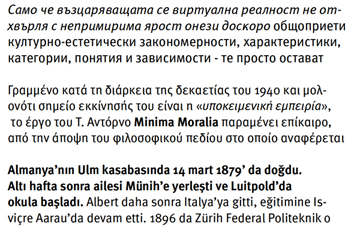
Over the last decade more and more Non-Western versions of FF Meta have been designed. If you need to set Baltic languages, Romanian, Turkish, Central European languages, Greek or Cyrillic, you can now get all of these in a package (with their Western cousins) in two basic weights, Book and Bold with their Italics. Go to Read More and see the PDF.


The PDF shows all the international Metas.
FF_MetaInternational.pdf

Futura – the perfect geometric typeface?

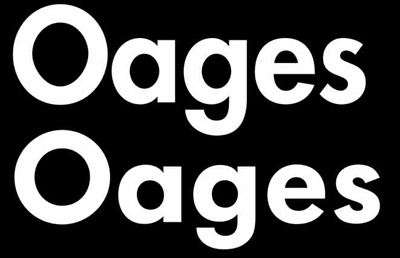
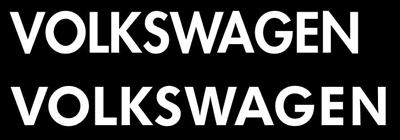
I have often found that supposedly perfect typefaces turn out to be less so on close inspection. Consider these examples for Futura: the version from Adobe (top in both examples) is clearly badly digitized. Early days, they were still learning — it’s not about blaming anybody, but about getting our client — Volkswagen — a decent typeface. If Futura’s O is supposed to look like a perfect circle, why does it look like an egg? And look at the counters in a, g, and e! Those are also supposed to be circular, not egg-shaped. So we took the typeface apart and reassembled it. If your VW had egg-shaped wheels, wouldn’t you complain? Or excuse it as an expression of the designer’s creativity?