Real Meta Numbers

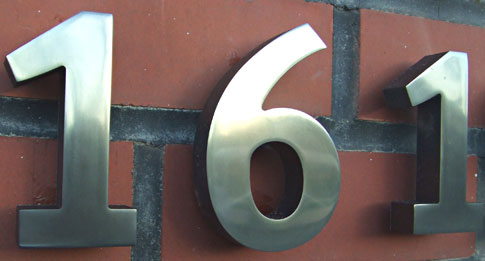
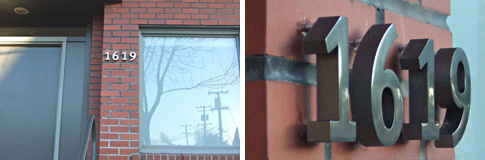
Yesterday I saw the first housenumbers in Real Life, on Jane and Louis’ office in Berkeley. The numbers are generously spaced to allow for conditions here in the USA, where people tend to sit in cars, looking for numbers quite far away. The number combination here presents a worst case scenario: two Ones which don’t need a lot of space and have a strong horizontal bar at the bottom, next to a 6 and a 9 that have to overshoot at top and bottom in order to look right.
Louis didn’t have a hammer drill, which made it very difficult to drill into a hard brick wall. That is why not all the holes are as precisely positioned as the templates would have allowed for. The 9 hangs too low. On paper, one would have to individually adjust the space between 1, 6, 1, 9. That, however, would be asking too much of your regular DIY homemaker, so I was not allowed to include kerning tables in the packages. Louis, on the other hand, is a journalist with more design savvy than a lot of designers I know, and he would have managed.

Normally, electric drills are not tools that type designers consider when planning for application of type on media.

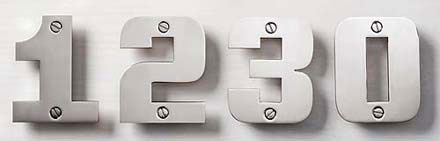
These are the Contemporary numbers, made from grey anodised aluminium, based on FF Meta Bold.
numbersBerkeley.jpg
dwr_numbersberkeleyclose.jpg

The 100 best typefaces

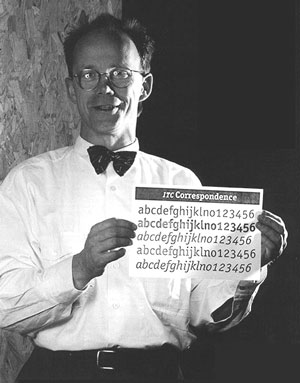
Jürgen Siebert’s Fontblog shows the countdown for the 100 best typefaces of all time. The criteria are discussed there – if you read German, that is. I can proudly announce that my ITC Officina came in at number 8, ahead of Gill and Univers, no less. There’s a new announcement every day, so in a week’s time we’ll know all the winners. The picture shows me in 1989, holding the first print of what was still called ITC Correspondence.

spiekermann_officina.jpg

New numbers please!

Here in the USA streets can be quite long, and housenumbers often run into five digits. The choice of numbers for this purpose, however, is pretty limited. What you see attached to most walls would not pass for professionally designed figures. This is how Rob Forbes, the founder of Design within Reach, also saw it. So he asked me whether I could do anything about that and design numbers that would work in three dimensions. An interview between Rob and myself is at
dwr_catalogspread.jpg

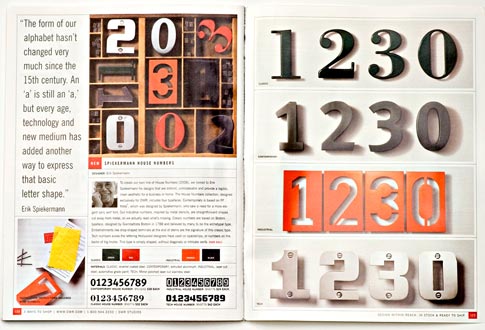
DWR have been listing the first four different housenumbers in their catalogue since the end of 2006 now. They are named for popular appeal, not necessarily after proper historical or typographical conventions.
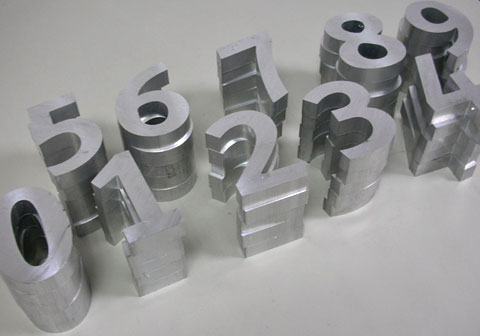
Classic is my own adaption of Bodoni; for Contemporary I somewhat rearranged Meta Bold, Industrial is a generic industrial typeface as negative stencils, and Tech is my attempt at designing numbers without any diagonal strokes. The materials are laser-cut, enamelled steel, extruded and anodized aluminium, laser-cut, painted steel and water-cut, polished stainless steel.
dwr_skizzen.jpg
tech1234.jpg

The Tech numbers have no diagonal shapes. This could eventually turn into a complete typeface.


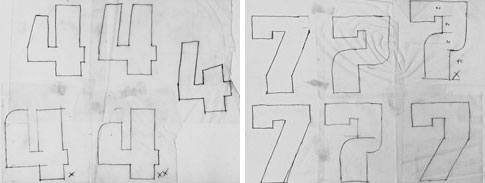
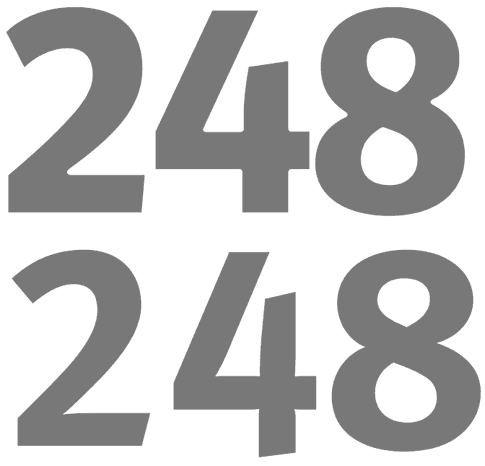
Even an accomplished face like Meta needs to be adapted to the production process. The routing tool for the aluminium extrusion can never achieve a finely pointed inner corner. Rather than leave the shape of these details to mechanical coincidence, I drew radii that would not present any problems in the tooling process. They do look somewhat exaggerated in the drawings, but work well in metal. The slighly bolder housenumbers are shown on top, with figures from FF Meta Bold below.

dwr_metaround.gif
dwr_alurohlinge.jpg

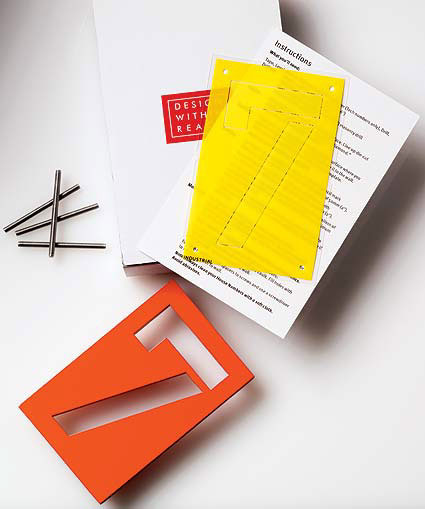
You need no typographic training to fix these housenumbers to the wall. The drilling templates are printed in yellow on clear acetate in order to be visible against any background, and they also provide proper spacing for the numbers.
house-number-installation.jpg

iErik

In November last year, the ISTD – International Society of Typographic Designers – organized a lecture tour through five cities in the UK and Northern Ireland. I have to be careful with the proper place names here. We tend to simply refer to Great Britain or – even worse – England. That would have been totally wrong, as the journey took us from Belfast via Glasgow and Manchester to Bristol and London. All that in five days, with two lectures each. I was privileged to have two colleagues in each city appear with me. The tour was called “Kern up the Volume”, and I had my own tour manager, chaperon, master of ceremonies and minder in Jonathan Doney, who was just as knackered as I was at the end of it. This was a kind of farewell tour as president of the ISTD. I am no longer PISTD, but PPISTD: Past President.

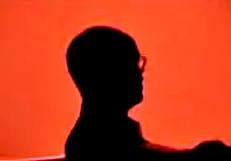
In Belfast Liam McComish, Course Director at the School of Art and Design, University of Ulster, recorded a little movie during question time and called it iErik. It is short and not destined for Hollywood, but the idea is great, so I put it under download.
iErik.jpg

007 digital

Everybody has probably noticed by now: this yeas is not abbreviated with two figures (like ’06), but with three: ’007. So much for branding’s influence on our language.
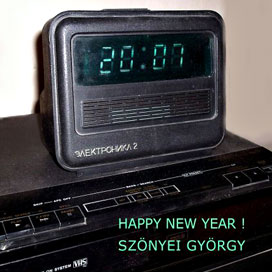
Of all the number associations in the mail this year, I liked this one best. It came from Szönyei György in Hungary, the designer of FF Archian. I have no idea why his alarm clock has cyrillic letters on it, but I’m glad he pressed the button on his camera at the right moment. This will work until 2059, and then again from 2100. If you have no better idea, you could simply sit down with a camera in front of one of the many digital timers in your home and wait for the right moment. Unless your VCR looks like mine: it has been blinking 12:00 ever since I bought it. And now it has become an antique.
2007_gyoergy.jpg

San Francisco

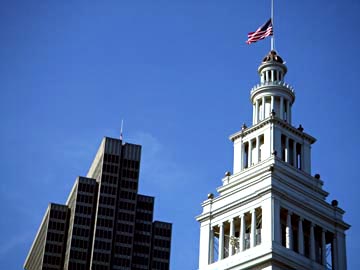
This may sound unfair when seen from Europe, but winter here in SF can be quite pleasant. The occasional rain makes sure there’ll be enough water next summer, but most of the time the sky is as blue as the picture shows.
sf0107.jpg

SpiekerBlog 2.0

At long last: only a few days into ’007, and my new blog goes online. The itinerary is up-to-date and now has its own page. The contact page is also new, and for good reason: my design studio moved to a new address last year. As of this week, it has also changed its name. UDN | United Designers Network is now SpiekermannPartners. The button on the top of this page goes right to the new homepage. Which, however, will not be online for a few days yet. You know how that goes: deadlines in the online world are as flexible as CSS stylesheets.
The new name is our answer to a recurring problem. After more than five years, clients and colleagues alike still think that I am with MetaDesign, the company I founded back in 1979. The studio appearing under my own name should send a clear message to everybody that I am out of Meta.
The new blog runs under Movable Type. We haven’t found any software that runs two versions parallel with just the text part being different. Seems there aren’t many blogs in two languages, if any. So we have to run two entire blogs on the server and I have to edit everything twice. Spiekermann.com/mt is German, spiekermann.com/mten sends you straight to the English language site. Joely Hegarty, friend and colleague in London, built the templates, learning blogging as he went along. Piece of cake for a proper coder like him. Thanks anyway.

Not the complete story of my life.

spiekermann_bw.jpg
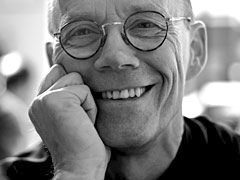
These are not extensive listings of all my achievements and failings, nor the complete story of my life (who would want to know?). Just the sort of cv people need to publish for events and publications.
There are two versions; a very short one in German and a short one in English.
> downloads

DBType wins German Design Prize.

The system of typefaces designed by myself and Christian Schwartz for Deutsche Bahn, the German state railways, just won the most prestigious design prize in the country.
designpreis.gif You don’t submit to this competition, you get proposed by one of the official design institutions in Germany. The actual medals will be handed out by the Federal Secretary for the Economy on 9 February, and officially we don’t know that we may have won the top prize in the communication category. Only 25 prizes were awarded out of 950 submissions. This, apparently, is The Prize of Prizes. It is as much an award for the political achievement of persuading a large bureaucratic institution to even commission their own typefaces, as it is for the design work.
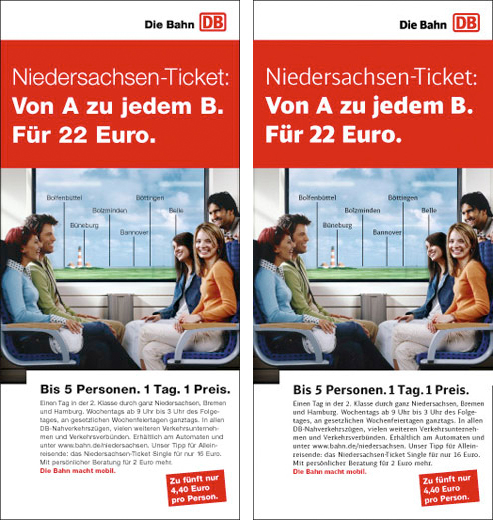
And here is some evidence of our work: an ad before and after, i.e. Helvetica on the left, DB Type Head on the right.

db01.jpg

typomania

This video is from the mid-eighties. Jonathan Dorney sent me a copy of a copy a few years ago. The quality is atrocious, but the content still amusing. Some people think so, anyway, as they keep asking me for a better version. There isn’t one, but there is this crappy 50mb one here as a download.