19. 04. 13
The state of typography
Not sure whether I agree with all the facts or the figures in this chart, but it still makes interesting reading:
Source: static.colourlovers.com via FontShop on Pinterest
by erik
Comments (39)
19. 04. 13
Not sure whether I agree with all the facts or the figures in this chart, but it still makes interesting reading:
Source: static.colourlovers.com via FontShop on Pinterest
by erik
Comments (39)
02. 02. 12
It really wasn’t designed for small sizes on screens. Words like milliliter can be very difficult to decipher. If you ever had to read or write a password with 1, i, l or I, you know the problem. That little comparison below is also available from the download page.
by erik
Comments (14)
10. 10. 11
This seems to be a “trending topic”. Just read about seven tips by Mark McGuinness to avoid Creative Block (yes, captitalized) and went on to look what I had written to Alex Cornell two years ago when he asked me “What do you do to inspire your creativity when you are in a rut?”
I sent my answer in a short email, without thinking about it too much, mentioning only six strategies. I have since added a seventh. BTW: Alex is writing a book about the topic, to be published soon by Princeton Architectural Press.
I have seven strategies for this situation:
1. Avoid
Do something else, wash the car, back-up your data, do errands…
2. Think
Sit back and think about the issue, just let your mind go…
3. Research
Look up stuff, go through your old projects, but avoid Google — it takes too long to find anything useful…
4. Collect
We all have lots of stuff; there must be something in there that is waiting to be used…
5. Sketch
Drawing is great, even if you have no talent. Just visualising the simplest things makes them come alive…
6. Deconstruct
Take the problem apart, look at the parts and then put them back together…
7. Talk
Find somebody to talk to. I cannot really think unless I talk, and as I do, ideas come up.
I have uploaded a little brochure from the series that we publish at Edenspiekermann now and again. This one features the essay by Heinrich Kleist “On the gradual completion of thoughts during speech”. The brochure has the text in German and English, and the languages start at either end of the printed piece. The PDF, therefore, needs to be turned around to read it properly in English.
by erik
Comments (7)
21. 07. 11
Here’s a video showing how it works. You can get the app from iTunes.
by erik
Comments (5)
19. 06. 11
MyFonts obviously have no quality control whatsoever. Or they would have noticed that the typeface they published under the name Silkstone was not only a blatant imitation of my ITC Officina, but that even the data is bad.

The copyright field in the font information shows no credit, but the perpetrator didn’t even bother to delete the date which shows when the original version was released, in this case 2003. (There have been various updates and new versions of Officina since its original release in 1989)

In order to either hide the source at least a little bit, a few letters were changed, e.g. the dot on the i was made square and the serif removed. But the j is the give-away: surely those changes should have also been applied to it as well? The same applied to the n and m. A little manipulation here, none there.

And, finally, this is how it was done: the complete font was extrapolated automatically, probably to make it look different. The result is a thinner and smaller letter (the red outline), with bad data where the automatic procedure would have required manual intervention to make it good. Obviously too much trouble for someone who’d rather pretend to be original than to actually do original work.
by erik
Comments (20)
16. 06. 11
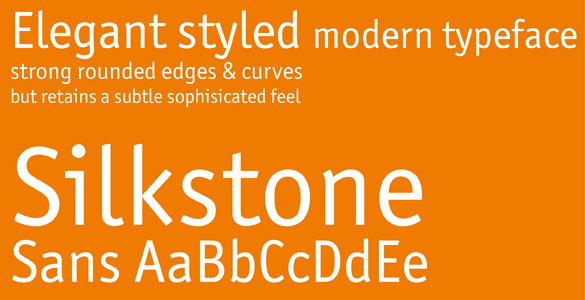
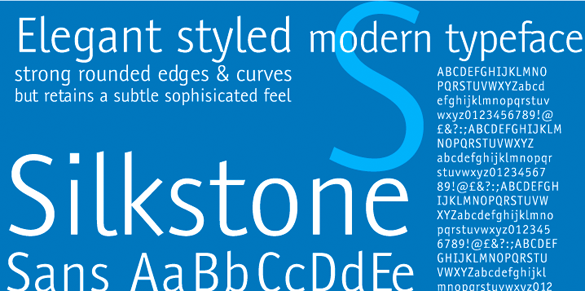
A new typeface that is introduced with such bad grammar (it should be “elegantly styled…” and “sophisicated” instead of “sophisticated” is a dead give-away) is off to a bad start. It only takes one look to see that this description
… The Silkstone Sans font was originally created to fill a void in the typeface market and is aimed at people looking for a classic elegant styled modern typeface suitable for a vast array of projects and designs. Designed and produced by Paul O’Connell of POCT, it is a sans serif typeface created with many flavours and influences, but still manages to retain its originality and is a tribute to many of today’s modern fonts …
is a load of bollocks. Silkstone Sans is an unashamed rip-off of my ITC Officina. Raising the crossbar on the e a little and straightening the top left on the n hardly constitutes a redesign (the m has been left alone), neither does extrapolating the face to a thinner weight. Making the i-dots square instead of round and taking the serif off the i takes away some of Officina’s strong character without adding originality, so why bother?
I am surprised that no-one at MyFonts saw this. It didn’t take very long after its release that lots of people saw it, recognized the deceit and tweeted about it. I am surprised that Paul O’Connell has had the nerve to so publicly expose his lack of shame. Or has stealing someone else’s work suddenly become something to brag about?
The original:
The fake: 
by erik
Comments (14)
21. 11. 10
Erik van Blokland’s little movie for his FF Kosmik is 20 old. A designer in Germany managed to open the original floppy disk on an old Mac and convert the QuickTime movie to the current MP4 format.
by erik
Comments (0)
10. 05. 10
It’s been around for a while. As off today also featured on the Spiekerblog: proper typefaces instead of system fonts.
Copy is set in Espi Slab Regular, Headlines in Espi Sans Bold, Twitter Feeds in Espi Sans Regular and Bold. Espi is Edenspiekermann’s exclusive version of FF Unit and FF Unit Slab. Done with Typekit.
Marcus Scheller hacked it all together.
You can also see real type in action on the Edenspiekermann site.
by erik
Comments (5)
06. 02. 10
A colleague wanted a copy of the logo for Glasgow ’99 that we designed at MetaDesign London back in 1997. When I looked for it, I found the movie that we made for the presentation at the time. Made in Director, not Flash, it is already a historical document.
Glasgow Typeface from erik spiekermann on Vimeo.
by erik
Comments (12)
18. 01. 10

Human capacity to make mistakes is unlimited, as Murphy formulates in the eponymous law. Bill Hill sent me this picture from California. The figure 3 appears six times. Why are the bottom figures upside down while all the others are the proper way round? Does the person who put the figures on that sign know something we type designers don’t know?
by erik
Comments (13)
© Erik Spiekermann | Spiekerblog is proudly powered by WordPress.